Vitamin D plays an important role in bone health, muscle function and the normal functioning of the immune system. But unlike many other nutrients, your vitamin D status does not depend on food alone.
Your body can also produce vitamin D when your skin is exposed to sunlight, which makes estimating your daily needs a little more complicated.
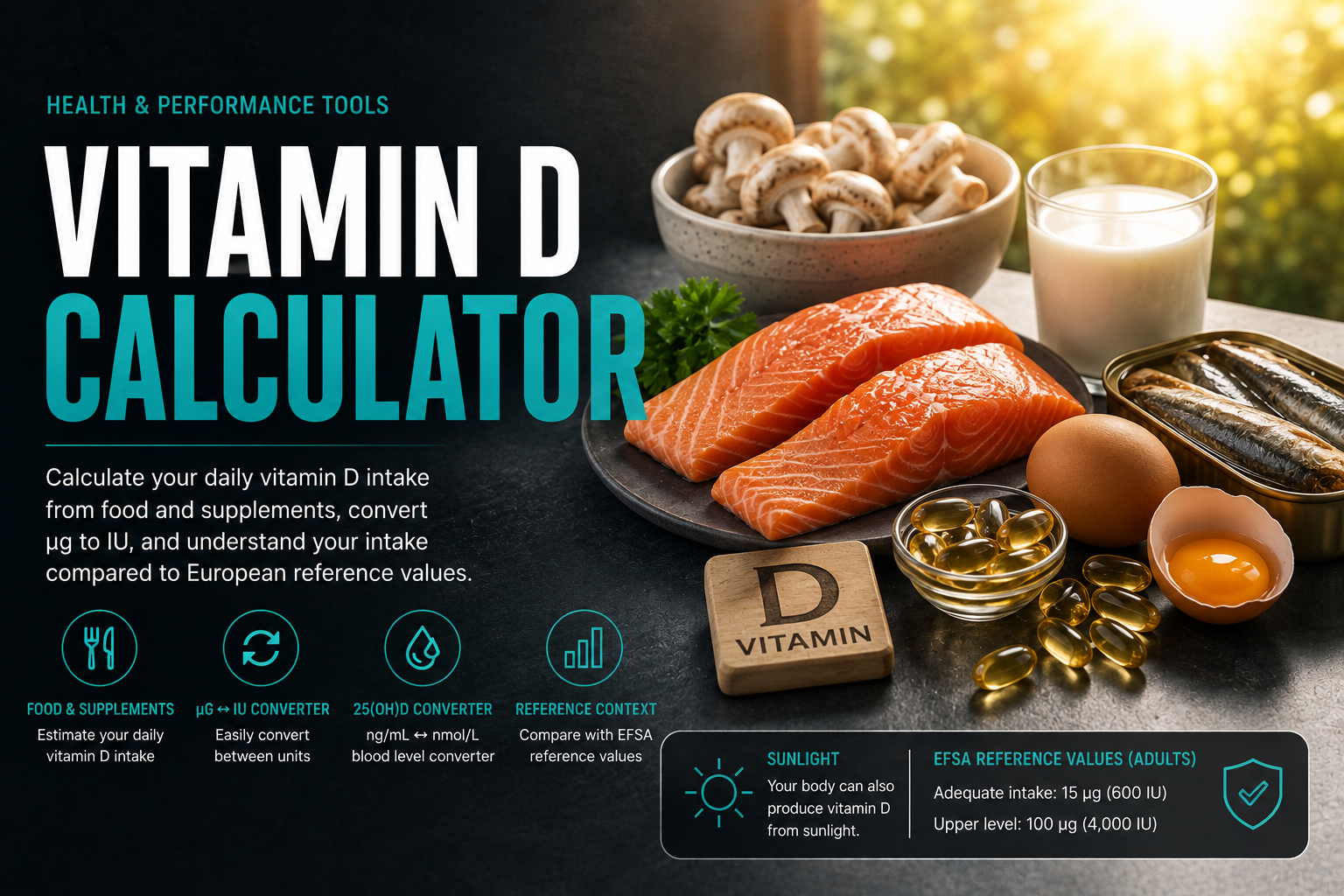
The VYVE lab Vitamin D Calculator helps you estimate your daily vitamin D intake from food and supplements, convert between µg and IU, and understand how your intake compares with European reference values.
If you already know your blood test result, you can also use the built-in 25(OH)D converter to switch between ng/mL and nmol/L.
Why Is Vitamin D Important?
Vitamin D is involved in several essential processes in the body.
It contributes to:
- Normal absorption and utilisation of calcium and phosphorus
- Normal blood calcium levels
- Maintenance of normal bones
- Maintenance of normal muscle function
- Maintenance of normal teeth
- Normal function of the immune system
Because of its role in calcium metabolism and bone health, vitamin D is especially important throughout life.
How Much Vitamin D Do Adults Need?
For healthy adults, the European Food Safety Authority uses an adequate intake of 15 µg per day, which is equivalent to 600 IU.
This reference value assumes minimal vitamin D production from sunlight.
That point matters because your actual vitamin D status can also be influenced by factors such as:
- Sun exposure
- Season
- Latitude
- Skin pigmentation
- Clothing
- Time spent outdoors
- Age
- Diet
- Supplement use
- Individual health factors
For this reason, a dietary calculator can estimate intake, but it cannot determine your exact vitamin D status.
Vitamin D: µg vs IU
Vitamin D supplements are commonly labelled either in micrograms or International Units.
The conversion is simple:
1 µg vitamin D = 40 IU
Examples:
- 10 µg = 400 IU
- 15 µg = 600 IU
- 25 µg = 1,000 IU
- 50 µg = 2,000 IU
- 100 µg = 4,000 IU
The VYVE lab calculator automatically converts between the two units.
Vitamin D Calculator
Calculate your estimated daily vitamin D intake from food and supplements, convert between µg and IU, and compare your intake with European reference values.
—
Your body can also produce vitamin D when skin is exposed to sunlight. This calculator only estimates vitamin D consumed through food and supplements and does not attempt to calculate vitamin D produced by sun exposure.
25(OH)D Blood Level Converter
Already know your laboratory vitamin D result? Convert serum 25-hydroxyvitamin D between ng/mL and nmol/L.
A laboratory result should be interpreted together with your health, medical history and other relevant factors. This converter does not diagnose vitamin D deficiency or determine a treatment dose.
This calculator is intended for educational purposes only. It estimates dietary vitamin D intake and does not determine how much vitamin D your body produces from sunlight or how much you should take to treat a deficiency. If you have a diagnosed deficiency, medical condition, take medications that affect vitamin D metabolism, or are considering high-dose supplementation, speak with a qualified healthcare professional.
What Foods Contain Vitamin D?
Vitamin D is naturally present in relatively few foods.
Good dietary sources can include:
- Fatty fish such as salmon, sardines and mackerel
- Cod liver oil
- Egg yolks
- Liver
- Some mushrooms
- Fortified dairy products
- Fortified plant-based drinks
- Fortified cereals and spreads
Because food sources are limited, many people rely on a combination of diet, sunlight and supplements.
Can You Get Enough Vitamin D From Sunlight?
Sunlight can contribute significantly to vitamin D production, but the amount varies widely.
UVB exposure depends on season, latitude, time of day, weather conditions, skin pigmentation, sunscreen use and how much skin is exposed.
In northern and central Europe, vitamin D production from sunlight may be limited during parts of the year.
This is one reason why vitamin D intake and supplementation are commonly discussed during autumn and winter.
However, the calculator does not estimate vitamin D production from sunlight because doing so accurately would require too many individual variables.
What Is 25(OH)D?
Vitamin D status is usually assessed using a blood test called 25-hydroxyvitamin D, often written as 25(OH)D.
Laboratories may report this value in either:
- ng/mL
- nmol/L
The conversion is:
1 ng/mL = 2.5 nmol/L
The VYVE lab Vitamin D Calculator includes a converter so you can easily switch between both units.
Can a Blood Test Tell Me How Much Vitamin D to Take?
A blood test can provide useful information about your vitamin D status, but it should not be used in isolation to determine a treatment dose.
The appropriate approach can depend on your current level, medical history, medications, age, diet and other factors.
High-dose vitamin D is sometimes used medically to correct deficiency, but therapeutic dosing should be supervised by a qualified healthcare professional.
Can You Take Too Much Vitamin D?
Yes.
Unlike water-soluble vitamins, vitamin D is fat-soluble and can accumulate in the body.
The European Food Safety Authority sets a tolerable upper intake level of 100 µg per day, equivalent to 4,000 IU per day, for adults.
Consistently exceeding this level without medical supervision is not recommended.
Very high vitamin D intake can lead to excessive calcium levels in the blood and may cause health problems.
Do You Need Vitamin D Supplements?
Not everyone needs the same amount.
Supplement use may depend on factors such as:
- Time of year
- Sun exposure
- Dietary intake
- Age
- Lifestyle
- Blood vitamin D status
- Individual health considerations
For some people, a supplement can be a practical way to help maintain adequate intake, especially when dietary sources are limited.
What Is the Best Time to Take Vitamin D?
Vitamin D is fat-soluble, so taking it with a meal that contains some dietary fat may help absorption.
Consistency is usually more important than the exact time of day.
Some people prefer taking vitamin D with breakfast or lunch simply because it is easier to remember.
Vitamin D2 vs Vitamin D3
Vitamin D supplements are commonly available as:
Vitamin D2 — ergocalciferol
and
Vitamin D3 — cholecalciferol
Both forms can contribute to vitamin D intake, although vitamin D3 is widely used in supplements.
Vitamin D3 can be sourced from animal-based ingredients or from vegan-friendly sources such as lichen.
Who May Be at Greater Risk of Low Vitamin D?
Certain people may be more likely to have low vitamin D status, including those who:
- Spend little time outdoors
- Live in regions with limited winter sunlight
- Cover most of their skin outdoors
- Have darker skin pigmentation
- Are older
- Have conditions that affect fat absorption
- Follow diets with very few vitamin D sources
Individual risk still varies, so blood testing can be useful when deficiency is suspected.
Frequently Asked Questions
How much vitamin D should I take per day?
There is no single supplement dose that is right for everyone. Your needs depend on diet, sunlight exposure, blood vitamin D status and individual health factors.
The VYVE lab calculator estimates your total daily intake rather than prescribing a supplement dose.
Is 1,000 IU of vitamin D a lot?
1,000 IU equals 25 µg of vitamin D.
This amount is below the EFSA tolerable upper intake level for adults, but whether it is appropriate for you depends on your total intake and personal circumstances.
Is 2,000 IU of vitamin D safe?
2,000 IU equals 50 µg.
This remains below the adult EFSA upper intake level of 4,000 IU per day, but higher intake is not automatically better.
Is 4,000 IU the maximum?
For adults, EFSA sets the tolerable upper intake level at 100 µg or 4,000 IU per day from all sources.
Higher doses may sometimes be used medically, but they should be supervised.
Can I get vitamin D from food alone?
It is possible, but vitamin D is naturally present in relatively few foods, which can make adequate intake more difficult for some people.
Does vitamin D help the immune system?
Vitamin D contributes to the normal function of the immune system.
What does my vitamin D blood level mean?
A 25(OH)D blood test helps assess vitamin D status. However, interpretation can vary depending on clinical context, laboratory reference ranges and individual health factors.
How often should I test vitamin D?
There is no universal testing schedule for everyone. Testing is generally more relevant when deficiency is suspected, supplementation is being monitored, or a healthcare professional recommends it.
Calculate Your Vitamin D Intake
Vitamin D intake can be confusing because supplements use different units and your total intake may come from several sources.
Use the VYVE lab Vitamin D Calculator to estimate your intake from food and supplements, convert between µg and IU, and compare your result with European reference values.
If you already know your 25(OH)D blood level, use the built-in converter to switch between ng/mL and nmol/L.
Calculate your vitamin D intake above and get a clearer picture of your daily intake.
The VYVE lab Vitamin D Calculator is intended for educational and informational purposes only. It does not diagnose vitamin D deficiency, assess vitamin D production from sunlight or determine a treatment dose. Individual needs may vary. If you have a diagnosed deficiency, medical condition, take medication that affects vitamin D metabolism or are considering high-dose supplementation, consult a qualified healthcare professional.
Share this:
- Email a link to a friend (Opens in new window) Email
- Share on Facebook (Opens in new window) Facebook
- Share on LinkedIn (Opens in new window) LinkedIn
- Share on WhatsApp (Opens in new window) WhatsApp
- Share on Threads (Opens in new window) Threads
- Share on X (Opens in new window) X
- Share on Pinterest (Opens in new window) Pinterest