Whether your goal is to lose fat, build muscle, improve performance or simply maintain a healthy weight, understanding your daily macronutrient needs can make nutrition much easier.
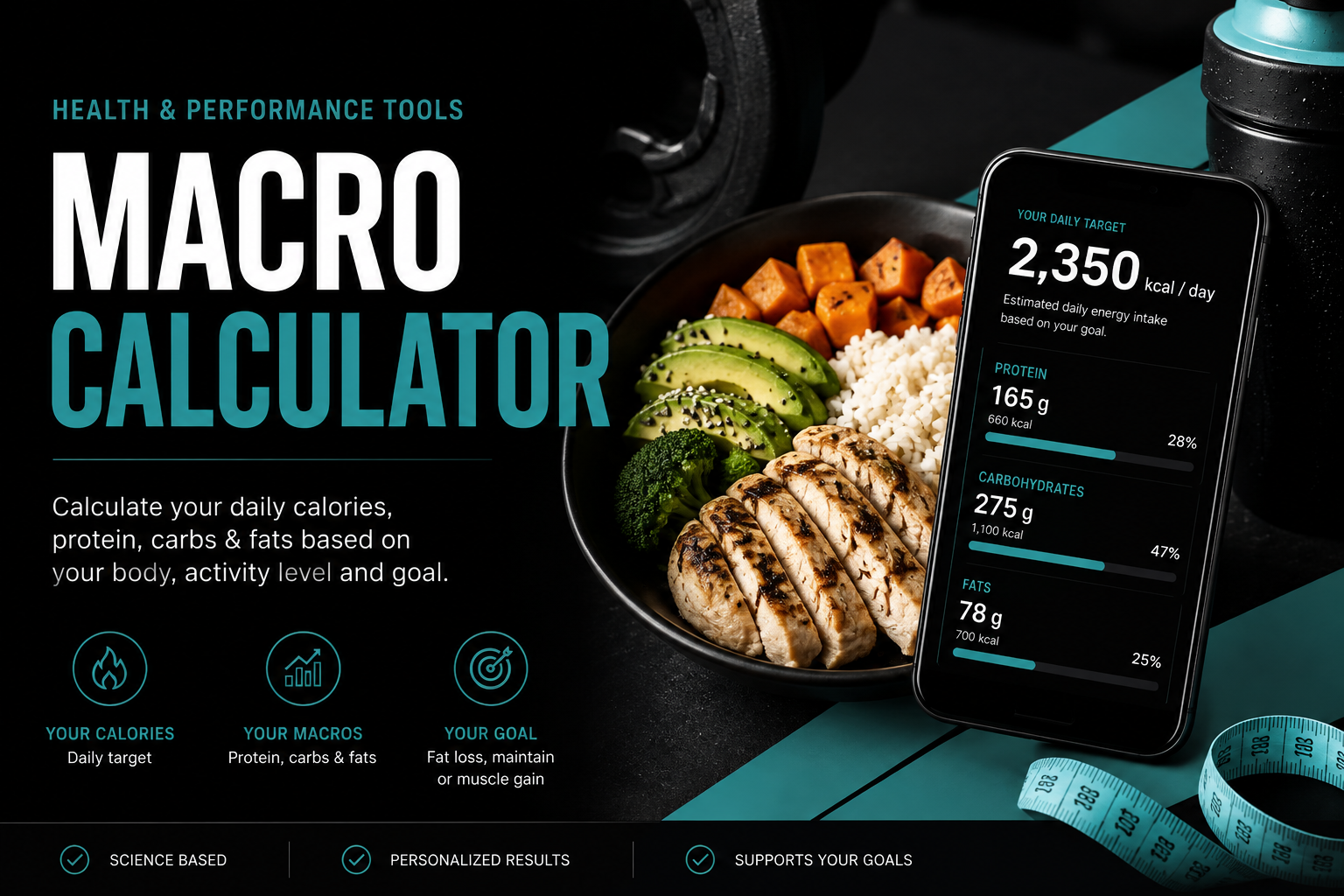
Our Macro Calculator estimates how many calories, grams of protein, carbohydrates and fats you may need each day based on your age, sex, height, weight, activity level and personal goal.
Simply enter your details, select your goal and let the calculator do the rest.
What Are Macronutrients?
Macronutrients — often called macros — are the nutrients your body needs in relatively large amounts to provide energy and support essential functions.
The three main macronutrients are:
Protein
Protein provides amino acids that your body uses to build and maintain muscle and other tissues. It is particularly important for people who exercise regularly, want to maintain muscle while losing weight or are working toward building more muscle.
Carbohydrates
Carbohydrates are an important source of energy for your body. They can be especially valuable during higher-intensity exercise, endurance activities and demanding training sessions.
Fats
Dietary fats provide energy, help your body absorb fat-soluble vitamins and contribute to many normal physiological functions.
Each macronutrient provides a different amount of energy:
- Protein: 4 kcal per gram
- Carbohydrates: 4 kcal per gram
- Fat: 9 kcal per gram
Finding the right balance between them can help you build a nutrition strategy that better supports your lifestyle and goals.
How Does the Macro Calculator Work?
The VYVE lab Macro Calculator first estimates your Basal Metabolic Rate (BMR) using the Mifflin–St Jeor equation.
BMR represents the approximate amount of energy your body requires at rest to maintain basic functions.
Your BMR is then adjusted according to your activity level to estimate your Total Daily Energy Expenditure (TDEE)— the approximate number of calories you burn throughout an average day.
Finally, your calorie target is adjusted according to your selected goal:
Fat Loss
The calculator creates a moderate calorie deficit below your estimated maintenance calories.
Maintain Weight
Your calorie target stays close to your estimated Total Daily Energy Expenditure.
Muscle Gain
The calculator adds a moderate calorie surplus to provide additional energy for training and muscle-building goals.
Your calories are then divided between protein, carbohydrates and fats to create your estimated daily macro targets.
Macros for Fat Loss
Fat loss ultimately requires your body to use more energy than you consume over time.
However, simply eating as little as possible isn’t necessarily a better strategy.
A moderate calorie deficit can make it easier to maintain energy levels, training performance and lean body mass while gradually reducing body fat.
Protein becomes particularly important during a calorie deficit because sufficient protein intake, combined with resistance training, can help support the maintenance of muscle mass.
Consistency matters more than chasing an extreme deficit.
Macros for Muscle Gain
Building muscle requires more than simply eating large amounts of protein.
Your body also needs enough total energy to support training, recovery and the muscle-building process.
A modest calorie surplus combined with adequate protein intake and progressive resistance training is often a practical starting point.
Carbohydrates can also play an important role because they provide fuel for demanding training sessions.
More calories don’t automatically mean more muscle. A controlled surplus can help support muscle growth while limiting unnecessary fat gain.
Macro Calculator
Calculate your recommended daily calories, protein, carbohydrates and fats based on your body, activity level and goal.
Estimated daily energy intake based on your selected goal.
Your estimated calorie needs are calculated from your basal metabolic rate (BMR), activity level and selected goal. Protein and fat targets are calculated first, with remaining calories allocated to carbohydrates.
This calculator provides an estimate for educational purposes only. Individual nutritional needs may vary depending on body composition, training volume, health status and other factors.
How Much Protein Do You Need?
There isn’t one perfect protein intake for everyone.
Your ideal intake depends on several factors, including:
- body weight
- physical activity
- training type
- calorie intake
- body composition
- personal goals
People who regularly perform resistance training or want to maintain muscle while losing weight will generally benefit from higher protein intake than sedentary individuals.
Instead of allocating protein simply as a percentage of total calories, our calculator estimates protein requirements relative to your body weight and selected goal.
How Important Are Carbohydrates?
Carbohydrates sometimes receive an unfair reputation in weight-loss diets.
But carbohydrates are not inherently responsible for weight gain.
Your overall calorie intake and energy balance are much more important.
For active people, carbohydrates can provide valuable fuel for exercise and help support training performance.
Your optimal carbohydrate intake can vary significantly depending on your activity level, training volume and personal preference.
Why Your Macro Targets Are Only a Starting Point
No online calculator can determine your exact nutritional requirements.
Equations provide an estimate, not a laboratory measurement of your metabolism.
Your actual calorie expenditure can vary because of factors such as body composition, genetics, daily movement, training volume and lifestyle.
Use your calculated macros as a starting point.
Follow them consistently for several weeks while monitoring relevant indicators such as body weight, measurements, training performance, energy and recovery.
You can then gradually adjust your calorie or macro intake based on how your body responds.
Frequently Asked Questions
What does a macro calculator calculate?
A macro calculator estimates your daily calorie needs and divides those calories between protein, carbohydrates and fats according to your body measurements, activity level and goal.
Should I count calories or macros?
Both approaches can be useful. Calories primarily determine your overall energy intake, while tracking macronutrients gives you additional information about where those calories come from.
For many people, monitoring calories and protein is already a practical starting point.
What is the best macro ratio for weight loss?
There is no single macro ratio that works for everyone. Successful fat loss depends primarily on maintaining an appropriate calorie deficit over time while consuming adequate protein and essential nutrients.
What is the best macro ratio for muscle gain?
Muscle gain generally requires adequate protein, sufficient overall energy and effective resistance training. Rather than relying on a universal percentage-based ratio, protein intake can be estimated according to body weight, with fats and carbohydrates making up the remaining energy requirements.
Do I need to hit my macros exactly every day?
No. Your nutrition does not need to be mathematically perfect.
Being reasonably close to your targets consistently is generally more practical than trying to hit every number exactly.
How often should I recalculate my macros?
Consider recalculating your macros after a meaningful change in body weight, activity level, training routine or goal.
Calculate Your Daily Macros
Nutrition doesn’t have to be complicated.
Use the VYVE lab Macro Calculator to estimate your daily calorie, protein, carbohydrate and fat targets and create a practical starting point for your nutrition strategy.
Calculate your macros above and start building a nutrition plan around your goals.
The VYVE lab Macro Calculator provides estimates for educational and informational purposes only. It is not intended to diagnose, treat or prevent any medical condition and does not replace individualized advice from a qualified healthcare or nutrition professional.
Share this:
- Email a link to a friend (Opens in new window) Email
- Share on Facebook (Opens in new window) Facebook
- Share on LinkedIn (Opens in new window) LinkedIn
- Share on WhatsApp (Opens in new window) WhatsApp
- Share on Threads (Opens in new window) Threads
- Share on X (Opens in new window) X
- Share on Pinterest (Opens in new window) Pinterest