How much water should you drink each day?
Your hydration needs depend on more than a generic eight-glass rule.
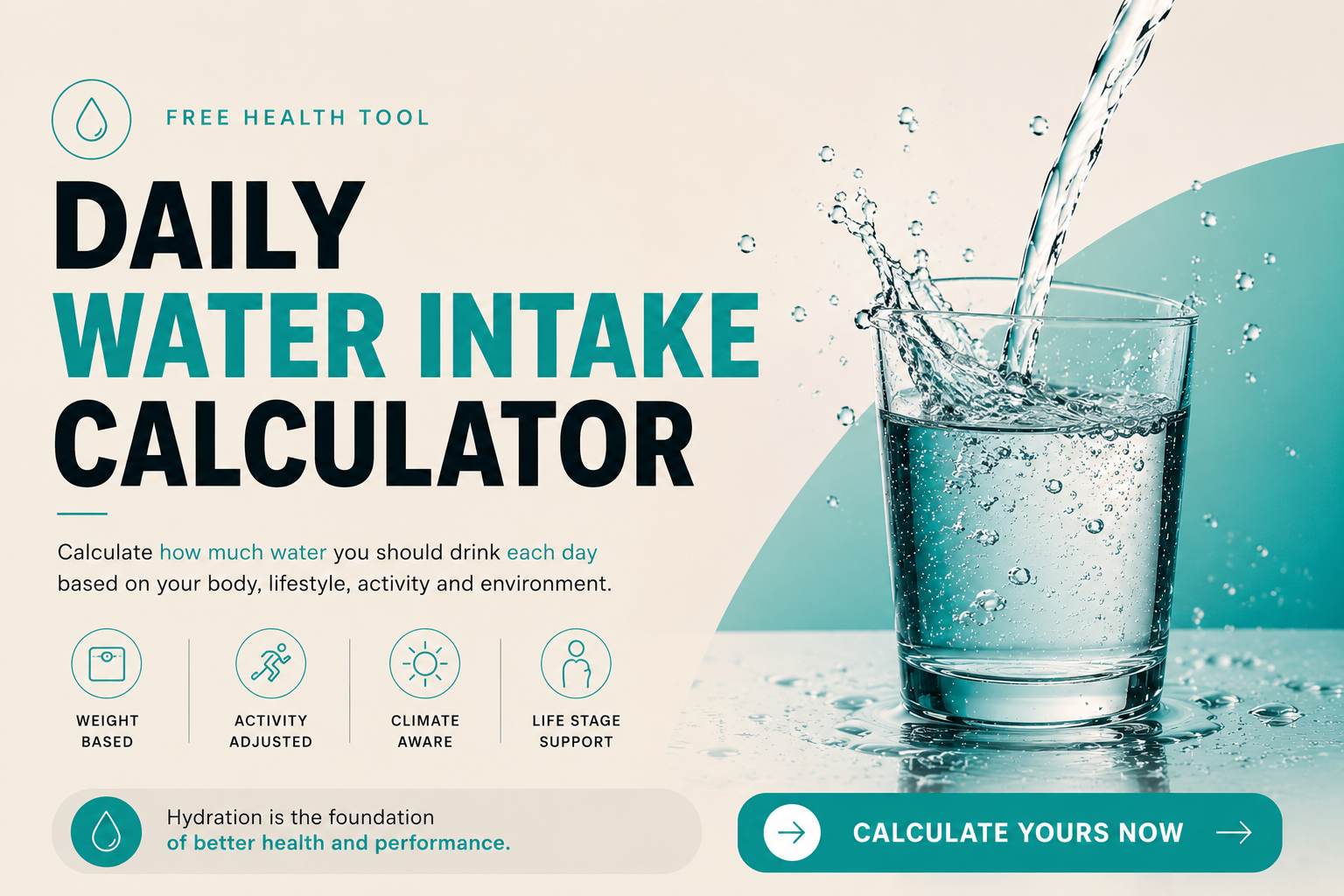
Use our free calculator to estimate your daily water intake based on your body weight, activity level, climate and life stage.
Simple. Practical. Evidence-informed.
Water supports almost every essential function in the body.
It helps regulate body temperature, transport nutrients, support digestion and maintain normal physical and mental performance.
But individual needs can vary significantly.
This calculator gives you a practical daily estimate and helps you understand how exercise, warmer conditions, pregnancy and breastfeeding may affect your hydration needs.
How the calculator works
The calculator estimates your daily fluid target using:
- your body weight,
- daily exercise,
- climate and environment,
- pregnancy or breastfeeding.
It then shows your estimated intake in:
- litres,
- millilitres,
- 250 ml glasses,
- 750 ml bottles.
The result also separates estimated fluid intake from total water intake, because part of your daily water usually comes from food.
Daily Water
Intake Calculator
Estimate how much water you may need each day based on your body weight, physical activity, climate and life stage.
Approximately 2,400 ml from water and other drinks.
Your hydration estimate
Simple hydration tips
Spread your fluid intake throughout the day.
Drink more during prolonged exercise and hot weather.
Water-rich foods and other beverages also contribute.
Why hydration matters
Even mild dehydration can affect how you feel and perform.
Adequate hydration supports:
- normal physical performance,
- concentration and alertness,
- body temperature regulation,
- digestion,
- nutrient transport,
- normal kidney function.
Your needs may increase during exercise, hot weather, illness, pregnancy or breastfeeding.
How much water do you need?
There is no single amount that works for everyone.
Daily hydration needs depend on factors such as:
- body size,
- physical activity,
- temperature and humidity,
- altitude,
- diet,
- age,
- pregnancy and breastfeeding,
- individual health conditions.
That is why personalised estimates are often more useful than a fixed daily number.
Do coffee and tea count?
Yes.
Coffee, tea, milk and other non-alcoholic drinks can contribute to your daily fluid intake.
Water is still an excellent everyday choice because it contains no calories or added sugar.
Caffeinated drinks can also contribute to hydration when consumed in normal amounts.
Does food count towards hydration?
Yes.
Many foods naturally contain water.
Fruit, vegetables, soups, yoghurt and other foods may contribute a meaningful part of your total daily intake.
The calculator therefore distinguishes between:
Total water intake
Water from food and drinks combined.
Fluid target
The estimated amount likely to come from beverages.
When should you drink more water?
You may need additional fluids when:
- exercising for longer periods,
- sweating heavily,
- spending time in hot or humid conditions,
- travelling to high altitude,
- experiencing vomiting, diarrhoea or fever,
- pregnant or breastfeeding.
During prolonged or intense exercise, electrolytes may also become important.
Signs you may need more fluids
Common signs of insufficient hydration may include:
- thirst,
- dry mouth,
- darker urine,
- headache,
- tiredness,
- reduced concentration,
- dizziness,
- lower exercise performance.
Urine colour can be a useful general indicator, but it is not a perfect diagnostic tool.
Can you drink too much water?
Yes.
Drinking excessive amounts of water in a short period can dilute sodium levels in the blood.
This condition can be serious.
More is not always better.
Hydration should be spread throughout the day and adjusted according to your body, activity and environment.
Simple hydration tips
Start early
Drink water after waking rather than trying to catch up late in the day.
Build a routine
Keep water nearby and drink regularly with meals and between activities.
Adjust for activity
Drink additional fluids before, during and after exercise.
Use visible reminders
A reusable bottle can make it easier to track your intake.
Include water-rich foods
Fruit, vegetables, soups and yoghurt can support hydration.
Do not rely only on thirst
Thirst can sometimes appear after fluid loss has already begun, especially during exercise or hot weather.
Frequently Asked Questions
Is eight glasses of water enough?
It may be enough for some people, but not for everyone.
Body weight, activity, food intake and climate all affect individual hydration needs.
Should I drink water even when I am not thirsty?
Regular fluid intake throughout the day is generally more practical than waiting until you feel very thirsty.
How much should I drink during exercise?
The amount depends on exercise duration, intensity, sweat rate and temperature.
Longer or more intense sessions usually require more fluid.
Is sparkling water hydrating?
Yes.
Plain sparkling water contributes to hydration in the same way as still water.
Can I count soup and fruit?
Yes.
Foods with a high water content contribute to your total daily water intake.
Should urine always be completely clear?
Not necessarily.
Very pale yellow urine is often considered a practical hydration indicator. Completely clear urine all day may sometimes suggest that fluid intake is higher than needed.
Should everyone follow this result?
No.
The result is a general estimate for healthy adults.
People with heart, kidney, liver or electrolyte-related conditions should follow professional medical advice.
Disclaimer
Important medical disclaimer
This calculator provides a general estimate for educational purposes only. It is not intended to diagnose, treat or prevent any medical condition and does not replace personalised advice from a qualified healthcare professional.
Individual fluid requirements may vary considerably.
People with kidney, heart, liver or electrolyte-related conditions, as well as anyone advised to restrict fluid intake, should follow guidance from their doctor or another qualified healthcare professional.